Tuesday, February 9, 2010

Interview with Jonathan Roberts (Part IV)

Check out our newest screen shot HERE
Welcome to part IV of our interview with Jonathan Roberts
27. What makes a good Pathfinder product? Virtual Table Top product?

I think what makes a good Pathfinder product is the same as what makes a good rpg product for any system. It has to be clear how the product can fit into an ongoing campaign and has to provide something that GMs wouldn't have created themselves. Most people are running campaigns that will go on over years with established groups. As much as everyone enjoys the odd one-shot adventure, it's better if an adventure can be incorporated into an ongoing campaign. It's also great if these adventures can bring something totally new to the table. With the Breaking of Forstor Nagar we're not only bringing a unique fantasy location to the table, we're also bringing a new table!

A good virtual tabletop product has to to work in the GMs favour. If it takes more time to learn, and sort out bugs or niggles than it saves during play then a virtual tabletop project has failed. We'll be creating a solid e-adventure first with a minimal implementation of the automatic bells and whistles first. Once we have the core of the product rock solid we'll add layers of automation onto that base with the end result of a product that's not only a great time saver, but also easy to pick up and use without a huge learning curve for those that are new to virtual tabletops.

Finally, all products, in whatever form need great production values. We'll be focusing on making sure that this product looks amazing.
28. What is your favorite Pathfinder product?

Oh come on - it has to be the core rulebook. This is what fantasy rulebooks should look like. It oozes style and atmosphere, and the bookmarked pdf is a joy. That was an amazing base from which to launch a new game system and Paizo knocked it out of the park.
29. What is your favorite Fantastic Maps product and why?


I love the Ice Temple. It was a fun take on a standard fantasy trope - the temple. I decided to think outside the box and challenge myself to make a truly fantastic location. The result - a temple inside a frozen waterfall that trapped an ancient dragon - was a great success. I'd certainly do some things differently now but I learnt a lot doing it. There may be products that are more widely useful - I mean who doesn't need a forest map for wilderness encounters - but I love locations that fire up the imagination.
30. What is your favorite Rite Publishing product and why?
My favourite has to be the Rituals of Choice adventure path. The scope of the project with the direct involvement of the patrons at every stage is creating an adenture of epic scope. It allows seeds to be sown early that will pay off far down the road - which fits with the flavour of the Arcana Evolved setting. I was also impressed with the level of care that goes into considering alternative solutions to encounters than the standard 'I kill it and take its stuff' approach. When a GM has this kind of preparation in front of them they tend to run the games differently, almost with the expectation that the players will solve encounters intelligently. I find players respond well to that. The Rituals of Choice adventures do an excellent job of including this degree of depth within a fixed pagecount.
I can't resist mentioning Colosseum Morpheon as well. Any adventure that promises dimension hopping chase scenes and fights that span a solar system has my vote!
31. What has been your best moment playing with an Virtual Table Top?
The best moments are still the standard ones - when they heard that the Lantern Man of Ylraphon was back (in a sequel to Richard Pett's The Styes). When they killed their first dragon. The virtual tabletop games have all the same great moments as your normal games. However there are some great moments that come from the unique advantages that a virtual tabletop provides. I'll never forget my players' first encounter with a gargantuan spider. Now that's a creature with some reach which, combined with it's own enormous size, meant that their torches couldn't see most of it when it was atttacking. The first they knew of the spider was when I revealed what they coud see in the cavern. They saw some pale strands and some large dark spiky lines. They didn't twig, until I rotated it just slightly. One guy said - "guys, did that just move. I don't think those are just set dressing - there's something really big in here". Of course as a good GM that was the perfect time to call for initiative.
32. What has been your most memorable fan response to Breaking of Fostor Nagar?
Awesome and gorgeous have come up a few times. People have really been liking the downloadable ship that I've made available and our first senior patron was very happy with the three masted square rigger that he got as a thank you for signing up. All patrons will get that and other assets as soon as the project hits goal. We've got an interesting selection of patrons so far - some new to VTTs, some old hands, some new to Pathfinder and some who've been playing it through the beta. I'm looking forward to getting the wide varieties of inputs as we put this together.
33. What role do you think Breaking of Fostor Nagar will play in the Pathfinder Rpg gaming community?
I think Breaking of Forstor Nagar will be a major event for Pathfinder. This will be the first adventure created within Pathfinder specifically for use with a virtual tabletop. In the process of creating the adventure we will be developing a framework for the Pathfinder rules that speeds up play for the GMs, and that framework will be available for all people to use in their home games. The existence of a commercially developed Pathfinder framework should be a major boon for the Pathfinder community, and the fact that Paizo have allowed us to create it speaks volumes about their commitment to support 3rd party publishing in all its forms. I think VTTs are likely to become more and more a part of mainstream gaming and I'd love Breaking of Forstor Nagar to be a landmark in that process.
We will also be porting Breaking of Forstor Nagar over into other VTTs - including Fantasy Grounds and TTopRPG. We aim for this to be an adventure that really showcases the capabilities of virtual tabletops.
34. Any plans on personally running a Breaking of Fostor Nagar?
I certainly will be! I have two groups that I regularly GM for and they will certainly be playtesting this. They have an --- inventive approach to tactics so they should give the adventure a pretty thorough run through.
35. Could you tell us a little about the difference between professional design and designing for play?
The biggest difference is in making sure that all the angles are covered. I know my groups, and though they can go off on some weird tangents I do know their standard tactics. If they're faced with a new city there are specific people they'll go off and talk to, certain locations that they'll want to know about. This lets me focus my time on those aspects of the game. When you're designing for a commercial product its important to consider every GMs group - and try to out guess all the players. Now that's clearly not possible so the trick is giving the GM enough of a safety net so that if the players go off in an unexpected direction the GM will have notes to hand that can cover it. All VTTs have the capability to really help with this through hyperlinks and text tied to locations so there should never be a moment where the GM is leafing through an adventure looking for the name of an NPC.
36. Why do you think this type of project has not been done before?
I think it's because a lot of things have come together now that make this possible. 4th edition does not have an OGL license that allows for the creation of computer adventures, so we couldn't do this kind of venture for 4th edition. In contrast Paizo have explicitly allowed us to create an e-adventure, and we've been developing this at full steam ahead since we got the okay from them. So yes, legally we couldn't have started any earlier!
The wonderful thing is that this comes at a time when Maptool is about to release a new stable version - 1.3. This version has an impressive feature list: initiative tracking, dynamic line of sight, light and vision, macros that allow the players and the GM to automate attacks, apply damage and healing, clickable room descriptions.... the list is extensive and opens up a wealth of options for lightening the GM's load. With this build going into a stable release it's the perfect time to create a commercial Pathfinder adventure.
We will be posting part V of this five part inteview on Friday. Your welcome to sign up as a patron today!

Saturday, February 6, 2010

Interview with Steven D. Russell (Small Press Week)

The fine folks over at the Rpg Bloogers Network decided to interview Steven D. Russell, Lord Protector of Rite Publishing as part of thier small press week fiind out more HERE.

Interview with Jonathan Roberts (Part III)


Click here for full sized image

Welcome to part III of our interview with Jonathan Roberts, about our newest patronage project The Breaking of Fostor Nagar (PFRPG) that will being using the MapTool program from RP Tools. Feel free to comment or ask additional questions. (Also don't forget to check out Jonathan Roberts map on the last page of Kobold Quarterly #11. )

17. How do you handle patron criticism of a map you design?

I hope pretty well. Every map is a bit of art to me, but the first role of any map is to be functional and a fresh pair of eyes is the best way to make sure that works. Patrons get input at the sketch stage and the stage where the line art is agreed. This makes sure the map corresponds clearly to the encounter and often provides invaluable feedback. This, coupled with close interaction with the designers, makes sure that the maps work well with the encounter. This is particularly important for complex tactical combats, where a piece of terrain can make all the difference.

18. Describe your best moment so far working on Breaking of Fostor Nagar?

I really enjoyed the back and forth work with Ben on the concept. That collaboration is great fun.


19. What do you feel was the most ingenious part of Breaking of Fostor Nagar that you or Ben McFarland have Designed?

I like the fact that the siege of the city places a clear time constraint on the adventure. The players are in a race against time to get the ambassador out before the city is overwhelmed. This allows us to design encounters where the players get to decide between going flat out to reach their goal, or pause and fend off the attackers. Both have their merits and their consequences. The adventure may also have a final chase scene where they have to escape the city, pursued by cannibals as the glacier crumbles around them. Now that's going to be a lot of fun.


20. What specific design choice are you most happy with, and why?

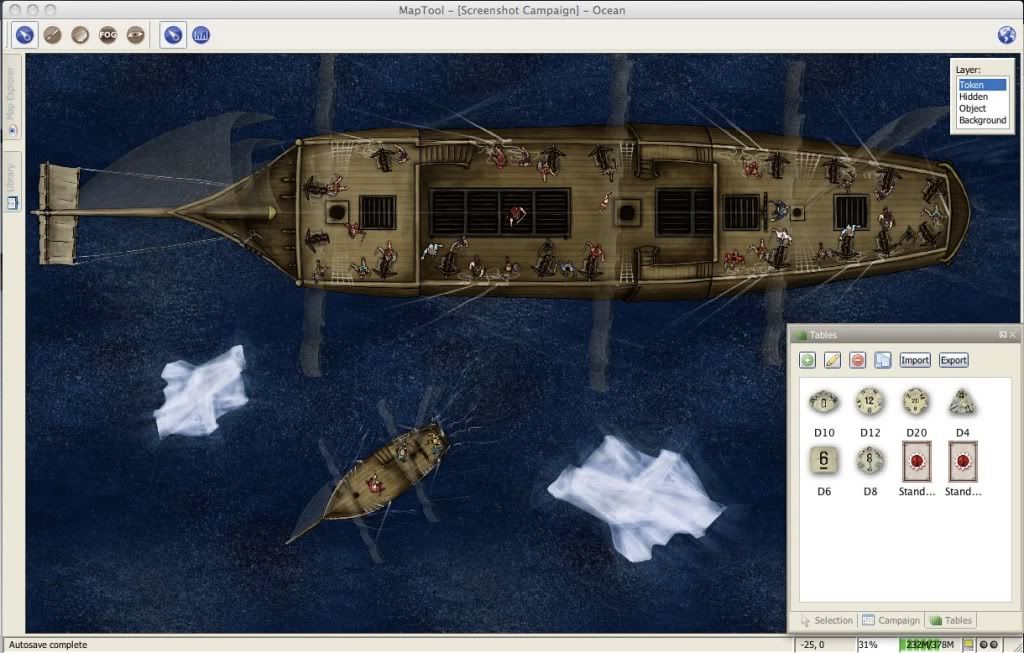
I think another advantage is that the tight timeline allows us to create a good mix of location based encounters and sequential events which will keep the adventure moving along at a good lick. On a less technical note - I love the concept of a siege coming from a fleet of ships. Ben raised the possibility when we were discussing an adventure based on the siege of a canal city with ships sailing between the buildings. We kept those beats in Breaking of Forstor Nagar by having the glacier city under siege and the ships sailing between the city districts that lie on the tethered icebergs. I've been having a lot of fun creating some full blown ships that can play host to some serious swashbuckling fun.


21. Which design element was the hardest to figure out, and why?

Actually I think this one will still be to come. We'll be making a decision during the development process about how much of the adventure to automate. Maptool has the capability to make everything automatic - so it can pop up windows asking if you'll be using rapid shot and then take that into account when you perform a full attack action on a hapless foe. There are frameworks in existence that have that degree of automation already in place. However with the extra automation comes added complexity for the user. We'll be testing this with patrons to find the happy medium where we can substantially speed up the game without introducing a large learning curve. I think this will be a unique opportunity to really get a feel for how the game should be played on a virtual tabletop.

22. What did you learn about development and especially development of a Virtual Table Top adventure?

I've been running games on maptool for years so I thought I had a pretty good handle on what can be done in the program. What I found when I started talking to Ben was that many of my adventure design choices have been subconsciously informed by what I felt was easy or doable in maptool. I found myself beginning to object to an idea because I couldn't quite see how we'd do it, but actually the ideas were so cool that I stopped myself and instead sat down to figure out how we could do it. Not only does that mean we keep the elements of the adventure that are the most fun, it also means that we should have some things in this adventure that should surprise even long time users of maptool.


23. What have you learned about Breaking of Fostor Nagar as you developed the screenshots?

We'll be needing a lot of tokens! A siege lends itself to crowd scenes, and we're lucky to have crowds of Devin's tokens to populate the streets, as well as having custom tokens for the 'named' NPCs. Also, I learned that a scale pirate ship looks fantastic on the computer screen as a player or a GM. when your players see that coming towards them they're suddenly going to start wondering about the safety of the boat that previously seemed quite large and comfortable. And even the most power mad PCs are going to think twice when they see a whole ships worth of ballistae swivel their way... and yes, they do swivel - all in synch.


24. Did you make any other mistakes or miscalculations in the development process? How did you fix them?

It's been interesting keeping the updates coming in time as we've been approaching goal. It forces you to make sure that everything get's done to a level that can be released to the public (or to patrons once development starts) rather than letting things stew for a while. I like the discipline of it. I've been involved in patronage projects as a freelancer for the maps before, but now being on the development side I have a lot of respect for those who have been running the development process in the past. It's been fun to take the reins and I look forward to guiding this through to the final product.


25. We have a long history of real world table top focus in the RPG industry how do you plan to overcome a “Grognards” hesitance to try out a Virtual Table top

Wait for the upcoming screenshots. They've been eye-candy up until now. The next set will start to show off some of the power of the program, and I'm sure that will begin to pique the curiosity of even the most dyed in the wool gamer. I don't believe we really have grognards in the hobby. I think it's more a matter of persuading people why they should be interested in a virtual tabletop. That's not going to happen unless people see what they can do with it.


26. Are you happy with where Breaking of Fostor Nagar is today (other than wanting more patrons)?

Yes, I think the Breaking of Forstor Nagar is in fine shape. We have a great team together and the adventure itself is a classic caper. I think it's going to be a blast and I can't wait to hit goal so we can get going in earnest.

We will be posting part IV of this five part inteview on Monday. Your welcome to sign up as a patron today!
Thursday, February 4, 2010

Interview with Jonathan Roberts (Part II)

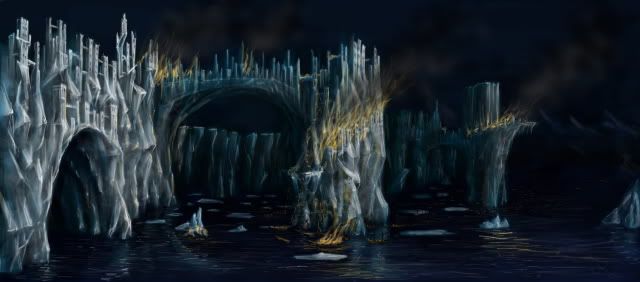
Illustration by Jonathan Roberts

Welcome to part II of our interview with Jonathan Roberts, about the upcoming and exciting patronage project The Breaking of Fostor Nagar (PFRPG) that will being using the MapTool program from RP Tools. So, without further ado, on with the interview! (You can find Part I HERE)

7. Could you give us a quick bio of your professional work?

Well Rite Publishing gave me my first professional job with the cartography for The Living Airship, and since then it's been pretty non-stop. I've done everything from space ship deckplans (Mongoose Publishing's Ships of Babylon 5) to cursed dwarven mines (Halls of the Mountain King for Open Design). My work tends to fall into regional maps, world maps, and encounter scale maps. I've worked for Mongoose Publishing, Rite Publishing, Open Design and Kobold Quarterly, Headless Hydra Games and a range of small publishers and private commissions. I've also set up my own series of pdf maps on RPGNow under the Fantastic Maps label for use in virtual tabletops play or to be printed out as battlemats.

I love fantasy cartography because the maps are always different. What other job would require you to draw a steampunk world on a gigantic cog or a series of islands suspended in trees?

8. So this is a PDF and POD (print on demand), will this have printable map packs like your Fantastic Maps imprint?

As well as working inside maptool as an electronic adventure, the maps will be available to patrons as printable map packs. Obviously these won't be as interactive as they will be inside the electronic adventure, but they'll be just as detailed and will be usable printed out at the table.

9. Why Maptool? Is there a concern that the technical aspects of a project like this could scare the traditional tabletop players away? If so how do you plan to overcome that?

I've been using maptool for years, ever since I moved country to Poland leaving my old gaming groups in the UK. Now I'm based in the US and it allows me to stay in touch with old friends. It's a great tool to allow gamers to connect. However it's also great at the tabletop. Now, when I play with people at the table, I still use maptool for myself so that I can keep track of line of sight, initiative, hit points and all the other things a GM needs to track to keep a game going smoothly. If possible, I hook up a second monitor to my laptop that the players can see, with only the player visible information. It makes such a difference to visualising the battlefield for tactical play. I find that when players can see the terrain they are a lot more likely to use it, and that has led to some great combats. So yes, I think the computer aspect is something that might be a little concerning to more traditional players, but we'll be making sure that we help people out with getting used to the software. Once you've used it you wonder why you haven't been using it all along.

It's clear that traditional gamers are interested in these tools. When the D&D Gametable was announced it generated a huge buzz and people were very disappointed when it didn't materialise. Maptool does precisely what the Gametable proposed, and it's free, cross-platform and open source. There's really no excuse not to try it out, and the community is very friendly and supportive if you get stuck. You can't buy that kind of product support and that's certainly one of the key factors in choosing maptool. We will also be doing conversions of the adventure into other VTTs (virtual tabletops) and we'll be talking more about those in due course

10. Could you please sum up "Breaking of Fostor Nagar" in a sentence or three?

The Breaking of Forstor Nagar will be a high fantasy race against time. The heroes must infiltrate and escape from a crumbling city of ice before it is overrun by the ravening horde.

11. How did you first become interested in creating Breaking of Fostor Nagar for the Pathfinder Rpg rather than standard 3.5 or 4E?

Pathfinder is the new kid on the block and has a great community behind it. It also has an open license that allows us to create an electronic adventure - something that would be a lot harder to do for 4th edition. But essentially I love Pathfinder. I play it in my home game and see it as the natural extension of 3.5 that I've been playing for years.

12. How did you feel, when you discovered you had your first patron?

Coming up with ideas for a product is a lot of fun, but it only starts becoming real when you persuade others to get excited too. Finding out that other people were as excited as I was to be part of this project was a great feeling. I'm greatly looking forward to hitting goal and really getting going on this.

13. Could you list some of your major influences in the initial artwork you created?

The idea actually came from an old adventure I ran. I sent my players into the mountains to parley with an orc tribe. I wanted the tribe to be more than just your standard bunch of humanoids to I placed them in a glacier and had them revere a dragon god. I was in the middle of describing the view as the players crested the hill when the idea hit me and suddenly the tribe of orcs lived in a city carved into a glacier with the head of the glacier carved into the enormous form of a dragon. The image stayed with my players for years and I've always wanted to revisit the concept. It was great to get this chance to actually sit down and draw a city carved out of a glacier - and then set fire to it!

14. What are the strengths of this project over other adventures and patronage projects?

One of the major advantages of this adventure is that it takes place in a remote location, allowing the adventure to be dropped into any GM's world. This means we can create a remarkable new environment for players to explore. It should be an entirely self contained adventure that plugged into any ongoing campaign.

We've got a great team of developers involved - with Ben McFarland (ENnie winning designer) on as the designer and author, Mark Moreland (editor of the Pathfinder wiki) keeping us straight on the pathfinder rules, James Hazelett (who many will know as DevinKnight and one of the Four Ugly Monsters) doing the tokens and Tyler Bartley doing the art. I'm really excited to have these guys on board and I'm sure we'll get a great adventure out of it.

15. Can you tell me about your experience so far of working with Rite Publishing Vs. Other publishers you have worked with?

Rite has been a great company to work for. As a small company of people who are very committed to the hobby they are very responsive during the development process of an adventure. They also have a habit of coming up with remarkable locations for me to map - from towering vertical dungeons with rope bridges to glass balconies over waterfalls. It's always fun to find out about the next Rite project.

16. Can you tell me how you felt when you got the finalized pitch for the adventure from the ENnie award winning Ben McFarland (Tales of Zobeck)?

The pitch was fantastic. I first worked with Ben when I was doing the maps for his adventure in the Halls of the Mountain King and he's a great guy to work with. He has a talent for really finding the essence of adventure in an idea. I love the way he took the concept and ran with it, coming up with a high stakes rescue attempt through an invading army of cannibals! I can't wait to work on the full blown adventure and find out what twisted plans he has in store. He's a great person to collaborate with and a veteran of the Open Design patronage project so patrons will have a great experience.

We will be psoting part III of this five part inteview on Wed. Your welcome to sign up as a patron today!

Jonathan Roberts Interview - Part One

Rite Publishing is talking with Jonathan Roberts today, about an upcoming and exciting patronage project The Breaking of Fostor Nagar (PFRPG) (Update: In production)that will being using the MapTool program from RP Tools. So, without further ado, one with the interview!


Thanks for talking with us today, Jonathan. I'm sure as excited to talk about this project as we are to ask about, so let's cut to the chase and drown our customers in information.


Are all adventure areas in the project going to be included entirely into the maptool version? In this case, I'm speaking of encounter area descriptions, encounter entity stats, cartography and the like.


All the encounter areas in the adventure will be included in maptool. Whenever you need to worry about position on a tactical scale, there will be a battle map. We will not provide battlemap scale maps for every non-combat encounter though. How often do you draw a battlemap for your players when they walk into a shop? In those cases, the adventure will use a larger scale map of the frozen city, so that the players know where they are.


As for the details of the areas - absolutely. The area descriptions, creature stats, trap details, lighting and hyper links to the relevant rules will be included for all of these areas. Equally the city map will have labels that can be made visible to players as the areas are explored, and include notes about the different locations. The idea is to place as much of the information within the maptool campaign as is useful. On the other hand, there will be some things that fit better in the pdf than in the maptool campaign. For example, we'll have a page or two in the pdf on the overall adventure structure and background, detailing the story arc. There's no real need to place that inside maptool, but of course if patrons feel otherwise then that will go in too.


Is there going to be a Pathfinder RPG character sheet for maptool that is integrated to use the proper variables in the adventure?


We will certainly store most of the important mechanical information about a character inside the campaign, but that's a little different from what you'd normally term a character sheet. Each character in maptool is represented by a token (basically a virtual mini). These tokens will have a basic set of properties (AC, CMD, CMB, Saves, Initiative, HP and so on) that can be filled in by players or the DM (monsters and NPCs will all be pre-statted of course). These will be interactive - so that when you take damage, you can click a button and it will update your token's Hp, and even place a marker that indicates if you are incapacited or dead. Players can see their current stats by mousing over their tokens. This will not be a complete reproduction of all the information on your character sheet. Character sheets in D&D have always been large and complicated affairs and there's information on your sheet that has no need to be included in maptool. We'll be focused on implementing the core elements that will speed up gameplay. And you can't doodle on a token, so we'll never completely replace the paper character sheet...


Are there going to be macros built into the adventure and character sheet that allows for some seamless DMing without alot of fore-work? (Such as die rolling macros, things that take CMB/CMD and such into account, interaction macros and so on)


Yes! Computers are great at rolling dice, so that will be built in. The adventure will come with macros that allow monsters to instantly roll complicated attacks (full attacking Marilith monk anyone?), allow players or the DM to apply damage or healing as well as taking advantage of maptool's built in functions such as initiative tracking and dynamic light and vision. Yes, there will be macros for combat maneuvers too, and template macros that players can customise for their characters. Patrons will get input on the degree of automation they want as well as walkthroughs on how to make the most of the automation in their games.


Are there going to be player handouts in the form of images, sounds, or dialogue that the DM can send to the players to help them understand an encounter area if one is provided in the print/pdf form of the adventure?


Handouts are a great part of tabletop play. Players always seem to fight over the piece of burnt paper the DM passes over the screen. We'll be making sure that works in the maptool adventure too. All of the interior art that you would expect in a pdf adventure will be included into the maptool adventure. When the PCs approach Forstor Nagar for the first time they will be able to see the nightscape of Forstor Nagar burning. When they meet important NPCs they will see their portrait when they mouseover their token. If they find a clue on the table, they'll be able to click it to see the text on the note. They can also collect these inside maptool and easily track the information and return to it whenever they need to.


Will fog of war be implemented?


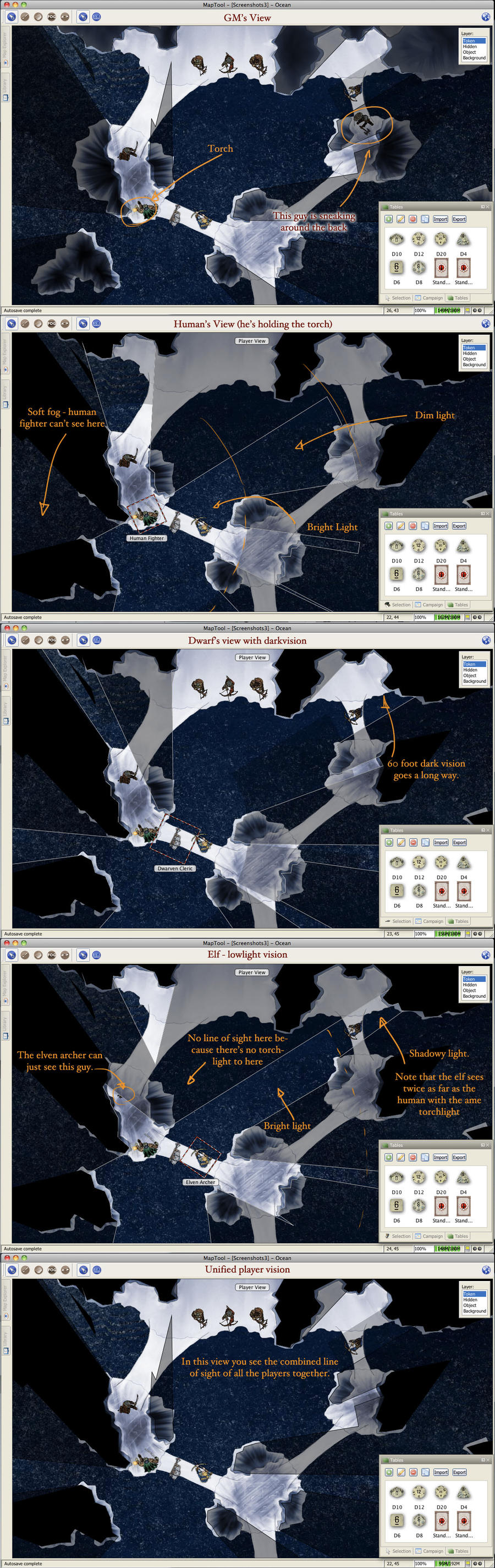
Absolutely. Maptool has vision and light built into it. So players will see what their character sees. The elf with low light vision will see twice as far as the human, but will still have to rely on the dwarf in complete darkness. The encounter areas will have the lighting built in, and if the players have a torch then that's in there too. This also calculates line of sight and leaves explored areas visible, so players can see where they've been (but hides monsters that aren't in line of sight, so the DM can still run ambushes!).


Will there be a primer for people who are new to Maptool?


Yep. I'll be running a couple of example sessions with patrons to get them familiar with the program. I'll also answer questions on the Rite forums. I'll also be directing people to the excellent maptool video tutorials that do a great job of explaining how the program works (http://rptoolstutorials.net/). If a patron is confused or having trouble, we'll take the time to sort it out.


While I hate cliffhangers as much as the next person, I think we'll put things on hold right there until our installment next week. Thank you, Jonathan, for talking with us about the MapTool Patronage Project and thanks to those reading these interviews, as well.